The Illusion of Timber
Not every wooden window is wood. And not every imitation is untrue. The world of heritage design has a quiet secret: the most convincing “timber” frames are often not timber at all.
For centuries, natural wood defined craftsmanship — painted sashes in Georgian terraces, deep-grained casements in Victorian cottages, hand-cut joints that creaked gently with the seasons. The look is irresistible because it feels honest. But modern materials have learned to tell the same visual story with greater resilience and far less compromise.
What we now call timber-alternative frames replicate the exact proportions, shadows, and grain of traditional joinery. Their lines are milled with such precision that even under scrutiny, the difference is nearly impossible to see. They don’t warp, rot, or demand yearly painting. And they weather not by fading, but by staying faithful.
This isn’t deception; it’s evolution. Technology has simply refined the appearance of authenticity until imitation became indistinguishable from origin. The artistry that once depended on a chisel now depends on design intelligence — the ability to reproduce charm without inheriting fragility.
The result is a new kind of truth in architecture: windows that look as they always did, yet live longer, perform better, and require less from their owners. Tradition remains visible; only the maintenance has vanished.
A Brief History of the Timber Ideal
Timber is woven into the story of British architecture. From medieval cottages to Georgian terraces and Victorian townhouses, wood framed the view of every era. Its warmth, its scent, its grain — these were marks of civilisation as much as construction. For generations, a well-made timber window was both a necessity and a signature of craftsmanship.
Carpenters once chose oak or pine not from romance but from practicality. Wood was abundant, workable, and capable of remarkable precision. Each joint and glazing bar was cut by hand, the design guided by proportion and light rather than machinery. The result was beauty born from skill, not indulgence.
Over time, the look of timber became a kind of shorthand for authenticity. We came to associate it with integrity, charm, and permanence. But the reality was harsher: the same material that gave homes their character also demanded endless care. Paint peeled, moisture crept in, and frames warped with the weather. Every winter tested the craftsmanship that summer had promised.
Still, the ideal of timber endured — not for what it was, but for what it represented: honesty, human touch, and the continuity of tradition. That ideal remains powerful, even as new materials quietly inherit its virtues. The appearance has stayed the same; only the substance beneath it has changed.

The Problem with Purism
We love the idea of “real wood.” It feels noble — a material with roots in craft and continuity. But purism can become its own kind of blindness. The insistence that only timber is authentic often leads to windows that look the part but fail the home.
Time exposes every weakness in wood. It swells, it shrinks, it breathes unevenly. Paint blisters, sashes stick, and softwood frames, however well made, surrender to rot. For listed properties and period homes, that deterioration carries a double cost: repairs are constant, and every change demands consent. Authenticity becomes exhausting.
The irony is that many so-called purists end up compromising the very appearance they wanted to preserve. Poorly maintained timber ages unevenly; mismatched repainting dulls the proportion; gaps and draughts distort the rhythm of a façade. The ideal collapses under its own upkeep.
Modern alternatives exist not to replace beauty but to preserve it more faithfully. They protect the aesthetic that timber once guaranteed, without the fragility that time exposes. The question, then, is not whether a material is pure — but whether it performs with integrity.
A heritage window’s worth isn’t found in its ancestry, but in its behaviour. The look of timber will always belong to tradition. But the burden of timber no longer has to.
The Rise of Timber-Alternative Frames
Innovation rarely arrives loudly. The evolution of the timber-alternative frame began quietly — in workshops where engineers studied the exact geometry of traditional joinery and asked how to reproduce it in more resilient form. The goal wasn’t to erase timber, but to perfect its performance.
Early uPVC imitations failed because they looked what they were: synthetic. But new generations of composite and heritage uPVC systems changed that. They replaced uniform plastic sheen with fine-grain textures and natural shadow depth. They introduced mechanical joints that replicate the precise angles of a carpenter’s mitre rather than the smooth welds of mass production. Colour palettes expanded to include subtle heritage tones — warm whites, muted creams, soft greys that emulate hand-painted finishes.
These advances transformed perception. Today’s timber-alternative windows are not pretending; they’re performing. They achieve superior insulation, minimal maintenance, and structural stability that timber can rarely match — yet their presence on a façade is virtually indistinguishable from the originals.
The beauty lies in their humility. They don’t announce themselves as modern; they simply behave as well-made timber once did, but longer, cleaner, and with fewer demands. It’s a quiet kind of innovation — progress dressed in familiarity.
Technology, in its most elegant form, isn’t futuristic. It’s invisible.

Seeing Is Believing: Craft in Disguise
The surest way to understand a timber-alternative frame is to stand beside it. From a distance of three feet, most people can’t tell it apart from real wood. From six inches, even trained eyes hesitate. The illusion isn’t deceit; it’s design mastery.
Modern timber-alternative systems are crafted to fool instinct, not intelligence. The grain patterns are embossed with microscopic irregularities that catch light like brushed wood. Hand-finished coatings mimic the subtle unevenness of painted layers. Even shadow depth — the tiny play between sash and glazing bead — is measured to replicate the tension of traditional joinery.
The tactile details are equally convincing. Run your hand along the frame and you’ll feel texture, not plastic. Tap it, and it sounds solid, not hollow. Each element has been engineered to evoke the quiet satisfaction of craftsmanship — proof that imitation, when done with reverence, becomes its own kind of artistry.
Side by side, genuine timber and a well-made alternative are almost indistinguishable. But their lives diverge over time. One will peel and warp under weather’s persistence; the other will remain steadfast, paint intact, lines true. The only difference that matters is endurance.
In the right light, even a conservation officer might pause — not because they’ve been fooled, but because they’ve witnessed what progress looks like when it keeps its manners.
Performance Beneath the Paint
Aesthetics win admiration, but performance earns trust. What lies beneath the paint is where timber alternatives quietly prove their worth. They don’t just resemble craftsmanship — they behave like progress.
At their core, modern timber-alternative frames combine multi-chamber insulation, rigid structural reinforcement, and low-conductivity materials that minimise heat loss. Every joint and seal is engineered for precision, ensuring draught-free comfort without compromising proportion. Many are paired with slimline double glazing, delivering the warmth of a modern home inside the silhouette of a period façade.
Maintenance is where the difference becomes undeniable. Timber demands routine — sanding, painting, re-sealing — a ritual of care as old as the craft itself. Timber-alternative systems, by contrast, ask almost nothing. Their finishes resist UV fading, moisture, and warping. They never flake, never peel, and rarely require more than an occasional clean.
Durability also brings sustainability. Extended lifespan means fewer replacements, less waste, and a lighter environmental footprint than fast-cycled timber production. Many modern composites are fully recyclable, aligning authenticity with responsibility.
Performance doesn’t betray tradition; it protects it. When windows stay warm, secure, and beautiful for decades, they honour the same principle that guided every good carpenter: build once, build well, and let the work speak for itself.

Approved by Heritage and Homeowners Alike
Authenticity is no longer a question of material, but of mastery. Conservation officers, once sceptical of timber-alternative frames, now recognise their role in preserving both architecture and practicality. When executed with precision, these modern systems satisfy the same visual criteria as their timber predecessors — and sometimes exceed them in longevity and efficiency.
Planning approval has evolved with technology. Today, heritage-sensitive uPVC and composite frames are often accepted in listed buildings and conservation areas where proportions, mouldings, and sightlines remain faithful to the original. The approval is earned not through persuasion, but through evidence: technical drawings, product samples, and past precedents that show continuity without compromise.
Homeowners, too, have adjusted their perception. What was once dismissed as imitation is now seen as intelligent preservation — a way to keep the character of the home intact without the burden of constant repair. The distinction between “real” and “replica” has blurred into a new category altogether: authentic performance.
This is where tradition finds its modern allies. By choosing advanced materials that honour heritage aesthetics, both planners and homeowners serve the same purpose — protecting the view that history created while ensuring it lasts for the next generation.
Heritage, after all, isn’t about resisting progress. It’s about recognising when progress has learned to respect the past.
Where Technology Keeps Tradition Alive
The most convincing tradition is the one that adapts. Today, craftsmanship lives as much in engineering as in carving. A timber-alternative frame isn’t a rejection of heritage — it’s its continuation, refined for how we live now.
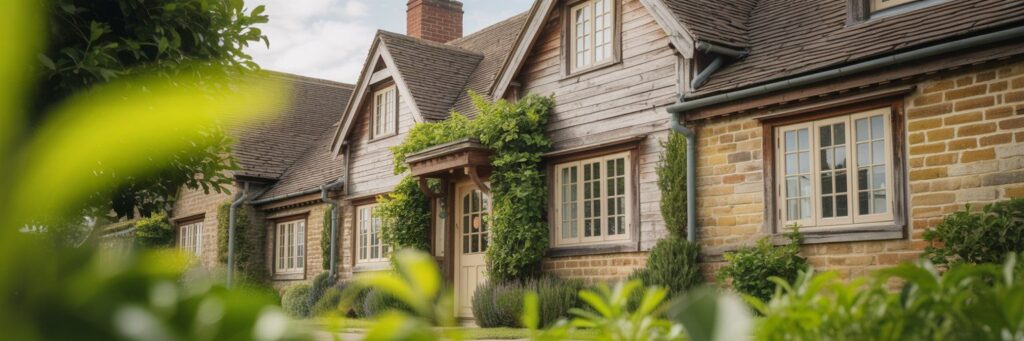
Walk through a row of Georgian terraces or Cotswold cottages, and you’ll see it: façades that look timeless, windows that seem original, yet function perfectly in modern conditions. Behind those elegant lines, concealed technology preserves what once decayed — weatherproof seals, insulated cores, precision joints that will outlast their predecessors by decades.
This harmony between old and new is what defines modern authenticity. The measure of a window’s worth isn’t whether it’s made of wood, but whether it honours what wood once promised — warmth, proportion, and quiet dignity.
At Cherwell’s Banbury showroom, you can see this philosophy in practice. Stand before traditional timber and its modern equivalents, feel the texture, watch the light play across both, and decide for yourself which tells the truer story.
Because the goal was never to abandon timber’s beauty — only to let it endure. Technology, done right, doesn’t erase tradition. It keeps it alive, one perfect frame at a time.