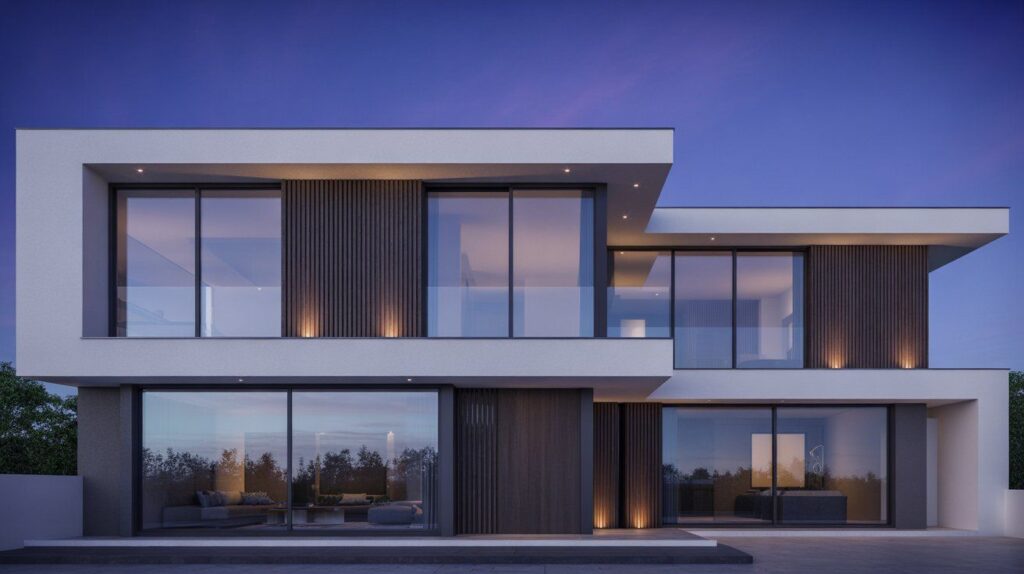
This Isn’t a Trend, It’s a Shift
Sliding doors are often described as a trend in high-end UK homes, but that framing misses what’s really happening. Trends come and go because they are driven by taste. Sliding doors, by contrast, are becoming common because they keep solving the same problems—across different sites, architects, and types of project.
When similar design decisions keep appearing in unrelated homes, it’s usually a sign of alignment rather than fashion. The solution fits the conditions.
High-end UK homes are shaped by a particular set of pressures: tight plots, close neighbours, planning scrutiny, variable light, and a desire for calm rather than spectacle. Within those conditions, sliding doors consistently emerge as the most resolved way of connecting inside and out. Not because they are exciting, but because they behave well.
This shift is easiest to see when you look at how decisions are actually made. Sliding doors are rarely chosen at the start as a stylistic preference. They appear later, once layouts, furniture, sightlines, and elevations have been tested. When other options introduce friction—spatially, visually, or behaviourally—the design often collapses back to a sliding solution.
That repetition is telling.
In many cases, sliding doors are not the boldest option available. They don’t perform theatrically. They don’t announce themselves as features. But they resolve problems quietly: they allow large openings without demanding clearance, they sit calmly in façades, and they adapt to daily use without asking for constant adjustment.
This is why they’ve become the default in high-end projects. Not because clients are chasing a look, but because architects are trying to remove friction. Sliding doors are chosen when the goal is not to impress in a single moment, but to support the home over time.
Seen this way, their rise isn’t about fashion at all. It’s about maturity. When a particular solution keeps being selected under pressure, it’s usually because it works. And in the context of contemporary UK homes, sliding doors have proved themselves not as a trend—but as a reliable architectural response.
British Homes Need Control More Than Openness
In the UK, the challenge is rarely a lack of openness. It’s a lack of control.
British homes operate under conditions that reward moderation rather than exposure. Light is variable, weather changes quickly, neighbours are close, and outdoor space is often limited. In this context, fully opening a wall to the outside is less useful than being able to adjust the relationship between inside and out with precision.
Sliding doors offer exactly that. They allow large areas of glass without committing the home to permanent openness. The boundary can be softened, shifted, or closed entirely without reconfiguring the room or changing how the space is used.
By contrast, systems that prioritise complete opening often create an all-or-nothing condition. In day-to-day use—especially outside peak summer moments—that level of exposure is rarely practical. It introduces behavioural friction rather than freedom.
High-end homes increasingly favour sliding doors because they make openness optional, not obligatory. On grey afternoons, glass still delivers light and outlook without exposure. On warm evenings, the opening can be adjusted to suit comfort rather than spectacle.
In British homes, openness is valuable—but only when it’s controlled. Sliding doors succeed because they respond to real conditions, not idealised ones.
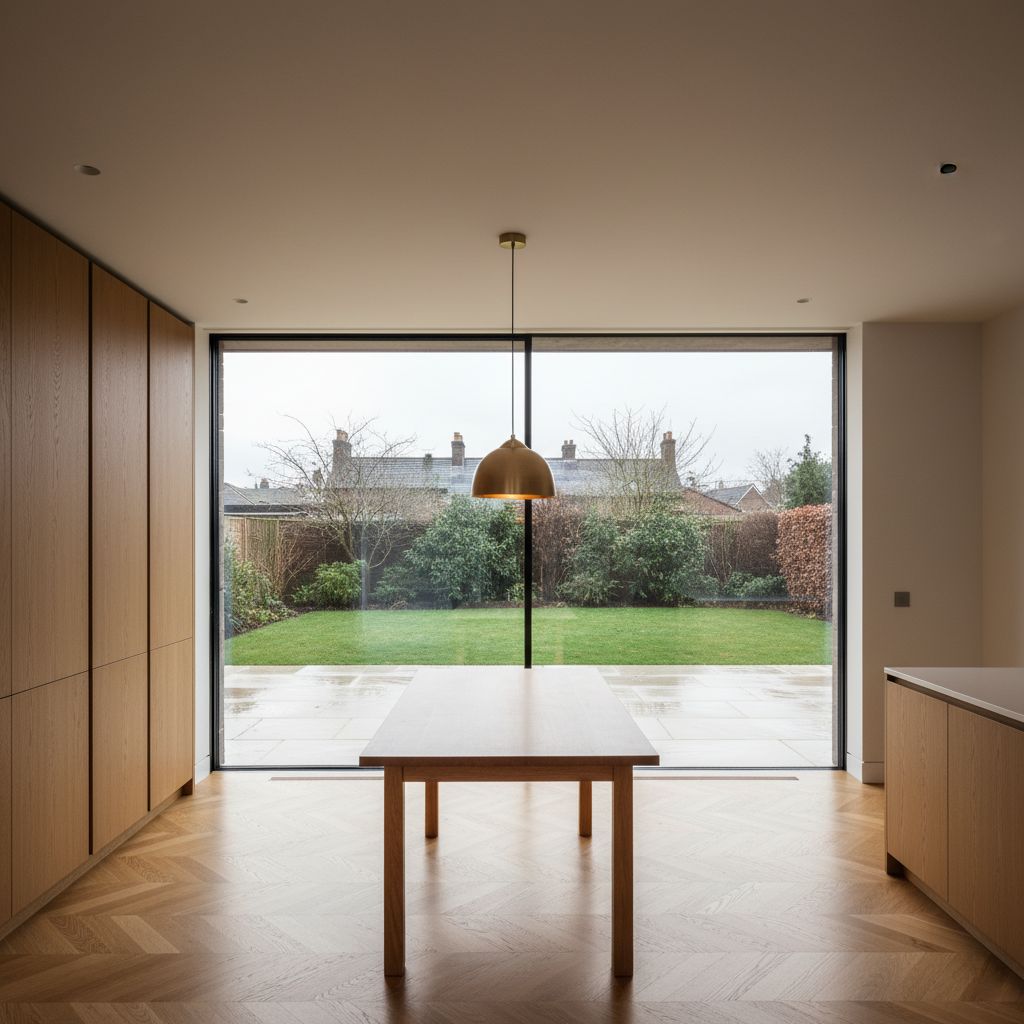
Sliding Doors Respect Space, Not Just Views
One of the least discussed reasons sliding doors dominate high-end UK homes is how they behave inside the room.
Swing systems require negotiation. Clearances must be protected. Furniture layouts become conditional. Circulation shifts depending on whether doors are open or closed. In carefully planned spaces, this instability quickly becomes frustrating.
Sliding doors preserve spatial logic. Furniture stays where it belongs. Circulation remains consistent. The room works the same way whether the door is open, closed, or partially open.
This matters in contemporary homes where spaces are multi-functional. Sliding doors allow living, dining, working, and entertaining to overlap without one mode disrupting another. The architecture remains calm because movement doesn’t reconfigure the room.
Sliding doors aren’t chosen only for the view they frame—they’re chosen for the space they protect.
Planning, Proportion, and External Appearance
Sliding doors also succeed because of how they sit externally.
Planning decisions prioritise proportion, rhythm, and legibility. Sliding systems maintain visual continuity when closed and avoid fragmented façades when open. Elevations remain composed.
In conservation areas and sensitive contexts, this matters. Sliding doors allow generous openings without turning the façade into a feature. They support architecture rather than dominating it.
From the outside, sliding doors are quieter. Fewer vertical breaks, fewer visual explanations of operation. That restraint makes them easier to integrate across architectural styles.
This clarity is one reason planners and conservation officers are often more receptive to sliding doors than alternatives.

Large Openings Without the Drama
Sliding doors allow scale without spectacle.
They create wide, uninterrupted openings that feel generous without feeling theatrical. There’s no collapse of panels, no visual event when the door is operated. The building remains composed.
High-end homes increasingly value this restraint. Sliding doors support connection without turning the opening into a performance.
Their success is measured by how often they’re used—and how little attention they demand.
Comfort, Performance, and Predictability
At the high end, comfort is non-negotiable.
Sliding doors behave like walls when closed—continuous, sealed, and stable. Thermal and acoustic performance remains consistent across changing conditions.
Ease of use reinforces this reliability. High-quality sliding systems move smoothly and predictably. They fade into daily routines instead of becoming points of attention.
In UK homes, where conditions change constantly, this predictability matters more than novelty.

Why Bifolds Are Becoming More Selective
Bifold doors haven’t disappeared—but they are no longer default.
They excel at moments of full openness, but outside those moments they often introduce visual fragmentation, spatial interruption, and behavioural compromise.
Sliding doors perform better in everyday conditions. They succeed in the in-between moments that define daily life.
Bifolds now work best where full opening is frequent and intentional. Elsewhere, sliding doors increasingly win on calm, clarity, and long-term usability.
Sliding Doors as an Architectural Decision
Sliding doors have become the default because they align with design-led thinking.
They resolve spatial, visual, behavioural, and planning constraints without demanding attention. They integrate rather than dominate.
Their rise reflects a broader shift in high-end UK home design—toward calm, maturity, and long-term liveability.
When something becomes the default at the high end, it’s rarely accidental. Sliding doors have earned their place by working quietly, consistently, and without drama.
They haven’t become the default because everyone wants them.
They’ve become the default because, time and again, they turn out to be the right decision.