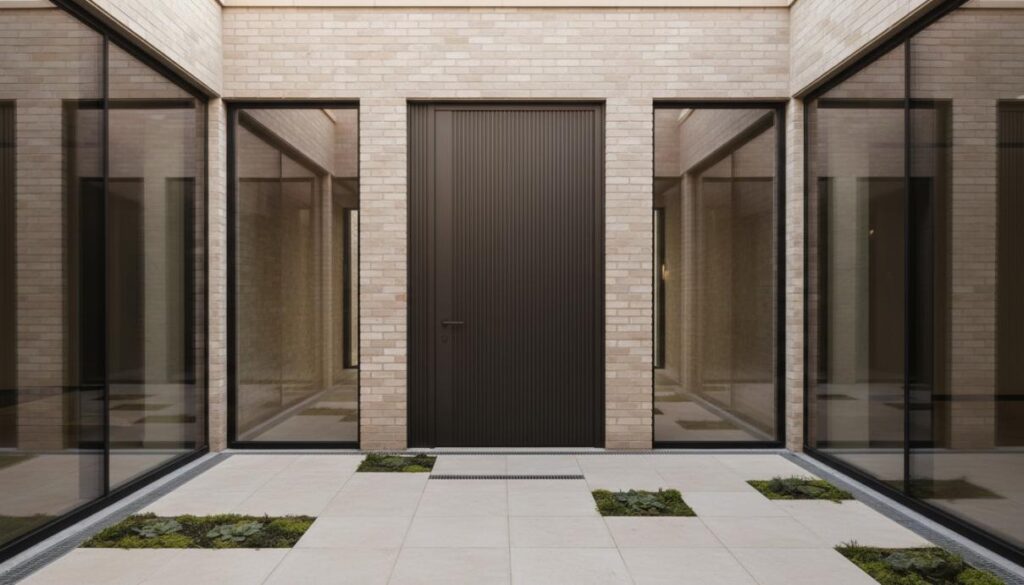
“Future-Ready” Is More Than a Marketing Phrase
The phrase “future-ready” is used frequently in home design. Yet in 2026, it carries a far more specific meaning than simply being modern or technologically advanced.
For sliding and entrance doors, future-ready is no longer about aesthetics alone. It is about resilience — to changing regulations, shifting climates, evolving lifestyles and long-term architectural expectations.
Doors are among the most permanent elements of a home. Unlike furniture or finishes, they are integrated into structure, insulation strategy and façade composition. Replacing them is disruptive and costly. Designing them with only today’s needs in mind is therefore a short-sighted approach.
The expectations placed upon homes are rising. Energy efficiency standards continue to tighten. Accessibility considerations are becoming more central. Climate variability is no longer theoretical. And households themselves are adapting — working from home more frequently, accommodating multi-generational living, or prioritising long-term comfort over short-term visual impact.
In this context, future-ready design becomes a philosophy rather than a feature list.
It asks: Will this sliding system still feel balanced if standards change? Will this entrance door support evolving security expectations? Does the threshold anticipate mobility needs that may not yet be present? Is the aesthetic restrained enough to endure beyond current trends?
Future-readiness is less about novelty and more about foresight.
In 2026, the most thoughtfully designed sliding and entrance doors are not those that make the boldest statement. They are the ones that settle quietly into the architecture — performing reliably, adapting gracefully, and remaining relevant long after the language of marketing has moved on.
Anticipating Regulatory Evolution
In the UK, regulatory standards rarely stand still.
Energy performance expectations have tightened steadily over recent years, and the trajectory is clear: reduced carbon emissions, improved insulation and greater whole-house efficiency. For sliding and entrance doors, being future-ready means anticipating this progression rather than merely complying with the present threshold.
Part L revisions have already reshaped how glazing systems are specified. U-values that were acceptable a decade ago now feel outdated. More importantly, there is growing recognition that performance is not defined by a single number on a data sheet, but by how the door integrates with the surrounding structure.
A highly insulated sliding system installed without careful perimeter sealing or threshold continuity will not deliver meaningful gains. Future-ready design therefore considers junction detailing, airtightness and installation methodology as integral to performance — not secondary concerns.
Security standards are evolving as well. Certifications such as PAS 24 and Secured by Design have become baseline expectations for many homeowners. Entrance doors, in particular, must balance refined appearance with robust locking and glazing integrity. As expectations rise, concealed strength and tested resilience become increasingly important.
Looking ahead, it is reasonable to expect further alignment between planning policy, energy targets and embodied carbon considerations. Systems designed with adaptability in mind — capable of accommodating upgraded glazing units or enhanced sealing — are better positioned to remain compliant without full replacement.
Future-readiness, in regulatory terms, is about margin. Not designing to just meet today’s requirement, but allowing room for tomorrow’s refinement.
When sliding and entrance doors are specified with this foresight, they contribute to a home that remains efficient, secure and compliant long after installation — quietly supporting evolving standards rather than reacting to them.

Climate Resilience in a Changing UK
Designing for the future in 2026 means acknowledging that the climate a door performs within is not the same as it was twenty years ago.
Sliding and entrance doors are increasingly expected to manage greater extremes — hotter summers, heavier rainfall, stronger winds and more variable seasonal shifts. Future-ready design responds not with over-engineering, but with calibrated resilience.
Solar gain is one of the most immediate considerations. Large sliding doors, particularly on south- or west-facing elevations, can introduce significant heat during prolonged warm periods. Thoughtful specification now looks beyond glass area alone and considers orientation, shading strategies and glazing performance to prevent overheating without sacrificing light.
At the threshold, weather performance has become more critical. Intense rainfall demands effective drainage detailing and carefully integrated seals. A future-ready system anticipates how water will behave at ground level, particularly where flush transitions are desired. The goal is not merely to resist ingress, but to manage water discreetly and reliably over time.
Wind exposure is equally relevant. In exposed rural or coastal locations, sliding systems must maintain alignment and smooth operation under pressure. Entrance doors need to close securely without distortion. Structural stability and hardware quality therefore contribute directly to long-term resilience.
Material performance also enters the equation. Finishes must withstand stronger UV exposure without fading prematurely. Components must tolerate thermal expansion and contraction without compromising seals or operation.
Importantly, climate resilience is not only about extremes. It is about maintaining consistent comfort year-round. A door that performs reliably in January frost and August heat contributes to a home that feels stable despite external fluctuation.
Future-ready sliding and entrance doors are therefore designed not simply for typical conditions, but for variability.
In a changing climate, quiet durability becomes one of the most valuable forms of design intelligence.
Accessibility and Inclusive Design
A truly future-ready home anticipates change — not only in regulation or climate, but in the lives of the people who inhabit it.
Sliding and entrance doors play a significant role in this long-term adaptability. In 2026, inclusive design is no longer viewed as a specialist requirement. It is increasingly recognised as thoughtful, intelligent planning.
Threshold design sits at the centre of this conversation.
Flush or low-level thresholds allow seamless transitions between inside and out, reducing trip risks and supporting ease of movement. What may feel like a refined architectural detail today can become essential over time — particularly as mobility needs evolve or multi-generational living becomes more common.
Wider openings also contribute to flexibility. A generous sliding system can accommodate not only furniture movement and entertaining, but future accessibility requirements without structural alteration. Designing for spatial generosity now can prevent costly interventions later.
Entrance doors deserve equal attention. Ease of operation, balanced hardware positioning and intuitive locking systems all influence daily comfort. Lever handles, accessible locking heights and smooth closing mechanisms may seem subtle considerations, yet they define how welcoming and usable a home feels.
Importantly, inclusive design does not require visible compromise. Contemporary sliding and entrance systems can integrate step-free thresholds, refined hardware and compliant detailing without sacrificing architectural clarity.
Future-readiness, in this sense, is about foresight rather than reaction. It recognises that households evolve. Children grow into adults. Parents age. Working patterns shift.
Doors designed with inclusive thinking at their core allow a home to adapt gracefully — ensuring comfort and independence remain embedded in the architecture for years to come.

Security Without Visual Compromise
Security has always been central to entrance and sliding door design. What has changed by 2026 is how discreetly that security is delivered.
Future-ready systems no longer rely on visible bulk or heavy framing to convey strength. Instead, reinforcement, locking mechanisms and glazing integrity are integrated within refined profiles — preserving architectural clarity while meeting increasingly rigorous standards.
Multi-point locking systems have evolved to distribute pressure more evenly across the door leaf, improving both security and weather performance. Laminated and toughened glazing combinations enhance resistance without altering sightlines. For sliding doors, concealed interlocks and reinforced meeting stiles contribute to stability without adding visual weight.
Entrance doors, in particular, must balance welcoming aesthetics with tested resilience. Certification standards such as PAS 24 have become expected rather than exceptional. Yet the visual language of the door need not become defensive. Carefully engineered cores, strengthened panels and concealed hardware allow the door to maintain elegance while meeting modern security expectations.
There is also a growing intersection between physical and digital security. Smart locking systems, remote access control and monitoring capabilities are becoming more commonplace. The challenge for future-ready design is ensuring these integrations remain adaptable. Technology evolves rapidly; doors must be capable of accommodating upgrades without requiring full replacement.
Importantly, security should not undermine comfort. Overly stiff operation or cumbersome hardware can detract from daily usability. The most thoughtful systems achieve strength and smoothness simultaneously — robust when required, effortless in routine use.
Future-readiness in security terms is therefore about integration. It ensures that resilience is embedded within the structure of the door, not layered awkwardly onto it.
When strength is quiet and confidence is inherent, sliding and entrance doors can protect the home without compromising its architectural intent.
Smart Integration and Digital Infrastructure
In 2026, doors are no longer isolated architectural elements. They are increasingly part of a wider digital ecosystem within the home.
Future-ready sliding and entrance doors must accommodate this integration — but with restraint.
Smart access systems are becoming more common, particularly at the entrance. App-enabled locking, temporary access codes for deliveries, and remote monitoring offer convenience and control. For sliding systems, integrated sensors can provide feedback on locking status or alert homeowners if panels are left unsecured.
Yet true future-readiness lies not in the presence of technology, but in its adaptability.
Digital systems evolve quickly. What feels advanced today may feel dated within five years. Premium door design therefore focuses on infrastructure — ensuring that cabling routes, hardware cavities and locking mechanisms can be upgraded without replacing the entire system. Flexibility matters more than novelty.
Compatibility is equally important. Doors should integrate seamlessly with broader smart home platforms rather than relying on proprietary systems that limit future choice. The architecture must remain coherent even as technology layers change.
There is also a question of discretion. Technology should not dominate the aesthetic of a carefully composed façade. Control panels, keypads and sensors need to be positioned thoughtfully, maintaining the clarity of the entrance while delivering functionality.
For sliding doors, automation may include soft-close mechanisms or assisted operation for larger panels. These features support usability without drawing attention to themselves. The goal is to enhance daily experience quietly.
Future-ready design in 2026 acknowledges that homes are becoming more connected. However, it also recognises that architecture should outlast technology cycles.
When digital integration is treated as a flexible layer rather than a defining feature, sliding and entrance doors can remain architecturally composed — even as the systems around them continue to evolve.

Aesthetic Longevity in a Fast-Moving Design Cycle
Design cycles are accelerating.
Colours trend on social media. Hardware finishes rise and fall in popularity. Minimalism gives way to maximalism and returns again. In this shifting landscape, “future-ready” increasingly means resisting the urge to follow every movement.
Sliding and entrance doors are highly visible architectural elements. Their scale, placement and finish contribute significantly to how a home is perceived. Choosing an aesthetic rooted in balance rather than novelty is therefore essential for long-term relevance.
Proportion is the foundation of timelessness.
Sliding systems that maintain clear rhythm — balanced panel widths, aligned head heights and considered solid-to-glass ratios — tend to age more gracefully than oversized expanses designed for immediate impact. A door that sits comfortably within the façade will remain coherent even as interior décor evolves.
Entrance doors, too, benefit from restraint. Bold colours and statement detailing can be effective when grounded in context. However, finishes chosen purely for contrast may date more quickly than neutral tones that complement masonry, cladding and landscaping. Texture and subtle material variation often endure better than overt visual drama.
There is also the relationship with the wider architectural language. Doors should respond to window proportions, rooflines and structural grid rather than compete with them. When alignment and hierarchy are respected, the façade feels composed rather than trend-driven.
Landscaping will mature over time. Planting softens edges. External materials weather naturally. A well-proportioned sliding or entrance door accommodates this evolution without appearing stylistically anchored to a single moment.
Future-ready aesthetics are therefore less about innovation and more about clarity.
When design choices prioritise balance, proportion and contextual awareness, sliding and entrance doors retain their relevance — quietly supporting the architecture long after faster-moving design cycles have passed.
Designing Sliding and Entrance Doors as Part of a Whole
By 2026, the concept of “future-ready” extends beyond the door itself.
Sliding and entrance systems do not operate in isolation. Their performance, longevity and relevance depend on how well they are integrated into the wider architectural framework — structure, insulation strategy, drainage planning and landscape design.
Early coordination remains fundamental.
When structural openings are sized with glazing systems in mind, beams can be concealed within ceiling lines rather than interrupting them. Threshold levels can align naturally with external terraces. Drainage can be resolved discreetly without compromising step-free transitions. These details determine whether a door feels seamlessly embedded or visibly accommodated.
For sliding systems, alignment with internal sightlines and external pathways reinforces spatial coherence. For entrance doors, placement relative to façade rhythm, approach landscaping and lighting design shapes first impressions. Future-readiness therefore includes aesthetic integration as much as technical resilience.
Lifecycle thinking is equally important. How will surrounding materials age? Will paving levels shift? Can hardware be serviced without invasive alteration? Designing doors as part of a coordinated system ensures that maintenance and upgrades can be addressed without structural compromise.
Collaboration underpins this process. Architects, structural engineers and glazing specialists must work in dialogue rather than sequence. When doors are introduced late, compromises tend to accumulate. When integrated from the outset, they support both architectural clarity and long-term performance.
Future-ready design ultimately recognises that doors are not accessories. They are thresholds between environments, between interior and exterior, between present needs and future change.
When sliding and entrance doors are conceived as part of a coherent whole — structurally, environmentally and aesthetically — they remain relevant not just at installation, but throughout the evolving life of the home.